

Amazon + Netflix = Retail Media
Amazon just connected shopping data to Netflix ads and CTV measurement will never look the same.

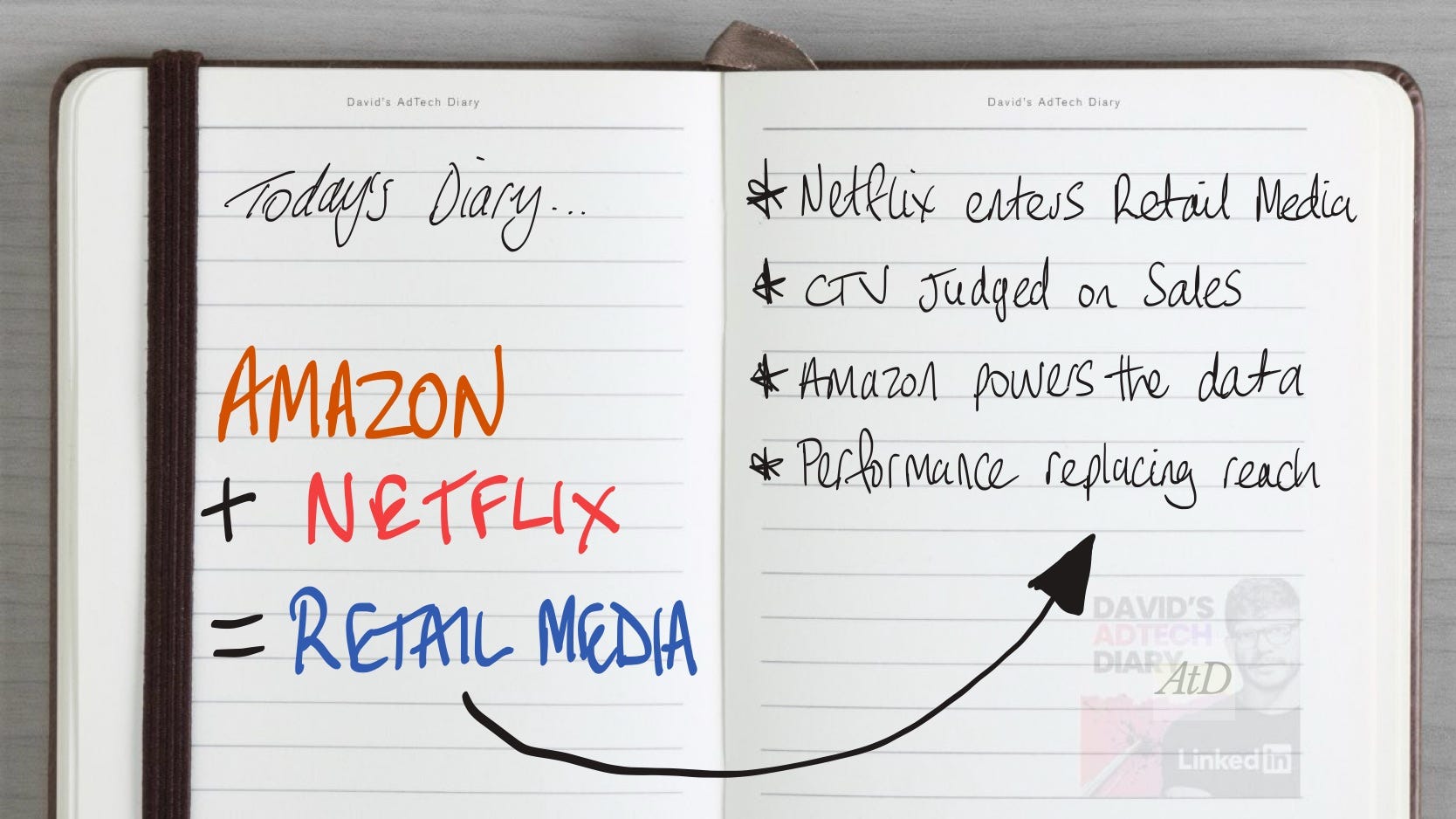
In the last few months three things have happened that, taken together, tell you exactly where Amazon (and retail media?) is going.
Netflix inventory is being integrated with Amazon DSP audiences.
Amazon has rolled out a new signal based attribution model.
Its Podcast Audience Network is now fully integrated into the DSP.
On their own these look like incremental product updates.
Together they reveal a very different strategy.
Amazon is turning its commerce data into the operating system for premium media.
Not retail media.
All media.
This is where the industry conversation should probably start.
Instead most people are still arguing about CPMs.
Netflix inventory inside Amazon DSP is not the story people think it is
Let’s start with the Netflix announcement because that is the one that made headlines.
Beginning in Q2 2026 in the United States advertisers buying Netflix programmatically through Amazon DSP will be able to apply Amazon Audiences to those campaigns.
Those audiences are built from Amazon’s data signals.
Search behaviour.
Product views.
Purchase history.
Prime Video viewing.
In other words, the entire Amazon behavioural graph.
And Amazon is not shy about the scale of that graph.
The company describes it as being built from trillions of signals.
For a planner this means you can now target segments like:
People currently researching kitchen appliances.
Recent buyers of baby products.
Shoppers browsing premium skincare.
And you can deliver those ads inside Netflix.
That sounds simple.
But the implications are not.
Because Netflix is not just another streaming app.
It is one of the most premium brand safe environments available anywhere in digital media.
Historically, CTV buying in those environments has relied on fairly blunt targeting.
Age.
Gender.
Household demographics.
Broad contextual signals.
That works for reach planning.
It is less useful when someone asks the inevitable question.
Did this actually sell anything?
That is the problem Netflix is trying to solve.
This is where the problem with CTV measurement starts
CTV has always looked fantastic in a media plan.
Large screen.
High completion rates.
Premium content.
It feels like television.
But the measurement story has always been messy.
Many CTV buys still rely on view through attribution models that are extremely generous.
An ad appears on a television screen.
Two weeks later someone buys something online.
The ad claims credit.
Whether the ad actually influenced the purchase is another question entirely.
That gap between perception and proof has held back a lot of performance budgets from flowing into CTV.
Retail media changes that dynamic.
Because retail media has something television historically never had.
Purchase data.
Amazon knows when someone searches for a product.
It knows when they view it.
And it knows when they buy it.
Connecting that data to advertising exposure is incredibly powerful.
That is exactly what this Netflix integration is designed to do.
Netflix impressions can now be connected to Amazon shopping behaviour.
Which means planners can begin to ask more serious questions.
Did exposure to a Netflix campaign increase product searches?
Did it drive incremental purchases?
Did it generate new to brand customers?
These are the metrics that performance teams actually care about.
And suddenly Netflix can start answering them.
But Netflix is only one piece of the machine
The bigger story is not Netflix.
It is Amazon DSP.
Because Amazon is steadily turning that DSP into the backbone of its entire advertising ecosystem.
Think about the surfaces that already sit inside that environment.
Fire TV inventory.
Third party CTV supply including Roku partnerships.
Display across the open web.
Streaming audio.
Now podcasts.
All of these surfaces can be bought through the same platform.
And all of them can use the same audience signals.
Those signals come from the one dataset most ad platforms do not have.
Commerce behaviour.
This is where the strategic shift becomes obvious.
Amazon is not expanding retail media.
It is exporting retail intelligence into the rest of the media ecosystem.
That is a very different ambition.
The podcast move makes the strategy even clearer
At the start of 2026 Amazon integrated Art19’s Podcast Audience Network directly into Amazon DSP.
That network includes more than 1,000 podcast shows.
For advertisers this means podcast inventory can now be planned alongside video, display and CTV within the same workflow.
The same audience segments apply.
The same analytics apply.
The same attribution framework applies.
Audio has always been a strange corner of the media world.
People spend a lot of time with it.
But the advertising market has historically underinvested.
Roughly 31% of media consumption time happens in audio environments.
Yet only around 9% of advertising budgets flow there.
That gap represents attention that is relatively cheap.
Amazon clearly sees that opportunity.
Podcast advertising also tends to score well on attention and recall metrics.
Listeners are often deeply engaged.
They are not scrolling.
They are not multitasking across five browser tabs.
They are listening.
Combine that attention with commerce data and the result becomes far more measurable than traditional radio advertising ever was.
Again the theme is the same.
Amazon’s data decides who you reach.
Amazon’s measurement decides what credit they get.
Attribution is quietly becoming the control system
At the same time Amazon has introduced a new signal based attribution model inside Amazon DSP.
Previously the platform used a fairly standard 14 day view through attribution window.
If someone saw an ad and purchased within that window the impression could receive credit.
The new model is more selective.
Instead of a fixed window Amazon now uses an algorithmically determined attribution window per impression.
The system looks at the signals surrounding each exposure.
It decides which views are actually likely to have influenced the purchase.
And it assigns credit accordingly.
In practice this tends to compress attribution windows.
Fewer impressions receive credit.
Upper funnel placements are less likely to be over rewarded.
This aligns with a wider shift across the industry.
Platforms like Meta have already moved toward shorter view through windows for similar reasons.
Advertisers are increasingly sceptical of models that credit almost every impression with a conversion.
Amazon’s approach attempts to make view through attribution more defensible.
But it also introduces a new layer of complexity.
When the attribution model changes the historical comparisons become messy.
To address that Amazon introduced additional reporting metrics such as “Sales All Views” and “Purchases All Views”.
These replicate the broader attribution logic used previously.
In theory that allows advertisers to maintain year over year comparability while transitioning to the new model.
In practice it means every dashboard now needs careful explanation.
The real goal is not measurement accuracy
It is control.
Attribution frameworks determine which channels appear effective.
Channels that appear effective receive more budget.
Budgets determine which platforms dominate media plans.
By controlling both the targeting signals and the attribution logic Amazon effectively controls how performance is interpreted.
That is incredibly powerful.
Because once budgets flow through the platform the dependency becomes structural.
Agencies optimise within the system.
Clients evaluate results within the system.
Over time the system becomes the default.
This is where retail media collides with television
Traditional television buying was built around reach.
Ratings.
Audience demographics.
Frequency curves.
Retail media is built around outcomes.
Search behaviour.
Product consideration.
Purchase events.
Amazon is now merging those two worlds.
Netflix inventory is no longer just about reaching households.
It is about reaching households currently researching products.
Podcast ads are not just brand storytelling.
They are signals in a path to purchase model.
CTV impressions become measurable commerce events.
This fundamentally changes how video budgets will be evaluated.
If one platform can connect exposure to sales and another cannot the performance comparison becomes uncomfortable.
Guess which platform wins that conversation.
Agencies are going to feel this shift first
For agencies the operational impact is significant.
Amazon DSP now sits directly in competitive conversations that used to be dominated by The Trade Desk or DV360.
Any time CTV appears in a media plan Amazon becomes part of the discussion.
Not because of inventory.
Because of data.
A planner can now ask a fairly simple question.
Would you rather target a broad demographic segment on CTV or reach people who have recently searched for the exact product category you sell?
In many cases the answer is obvious.
Which means the centre of gravity in programmatic video planning may shift toward platforms with deterministic commerce data.
Walmart is already attempting something similar through Walmart Connect and its Vizio acquisition.
Kroger is building its own ecosystem.
Retailers understand that their purchase data is the asset everyone else lacks.
But Amazon still has the deepest integration between commerce and media.
That advantage is not disappearing any time soon.
There are second order effects most people are not modelling yet
Once commerce data drives media buying the format itself begins to evolve.
Expect more interactive and shoppable experiences inside CTV environments.
QR codes linked to product pages.
Click to buy overlays.
Voice assisted purchasing through connected televisions.
The line between advertising and commerce interface starts to blur.
What used to be a thirty second awareness moment becomes a transaction gateway.
That has implications for creative teams.
It has implications for measurement frameworks.
And it has implications for how consumers experience advertising inside premium content.
The industry is still adjusting to programmatic television.
The next phase is television that behaves like ecommerce.
This is why the Amazon DSP strategy matters
It is easy to look at these product announcements individually and treat them as tactical updates.
Netflix inventory available here.
Podcast inventory available there.
A new attribution model somewhere in the reporting stack.
But the pattern becomes obvious when you zoom out.
Amazon is building a unified advertising infrastructure where:
Commerce data defines audiences.
Premium media provides attention.
Algorithmic attribution determines value.
The same system then allocates credit across every touchpoint.
Display.
Video.
Television.
Audio.
This is not a retail media network... It’s an advertising operating system built on top of a commerce graph.
And it is slowly absorbing more of the premium media landscape.
The industry will continue to debate CTV CPM and Amazon will continue wiring shopping behaviour into television screens.
One of those strategies feels slightly more future proof.
Oh, and if you actually want to understand how this machine works under the hood, I literally wrote the book on it called WTF IS PROGRAMMATIC?
k, thanks, bye