

Amazon + Netflix Just Changed CTV In The UK And Europe
From 18 May in the UK and EMEA, advertisers using Amazon DSP can apply Amazon shopping and behavioural data directly to Netflix ad inventory.

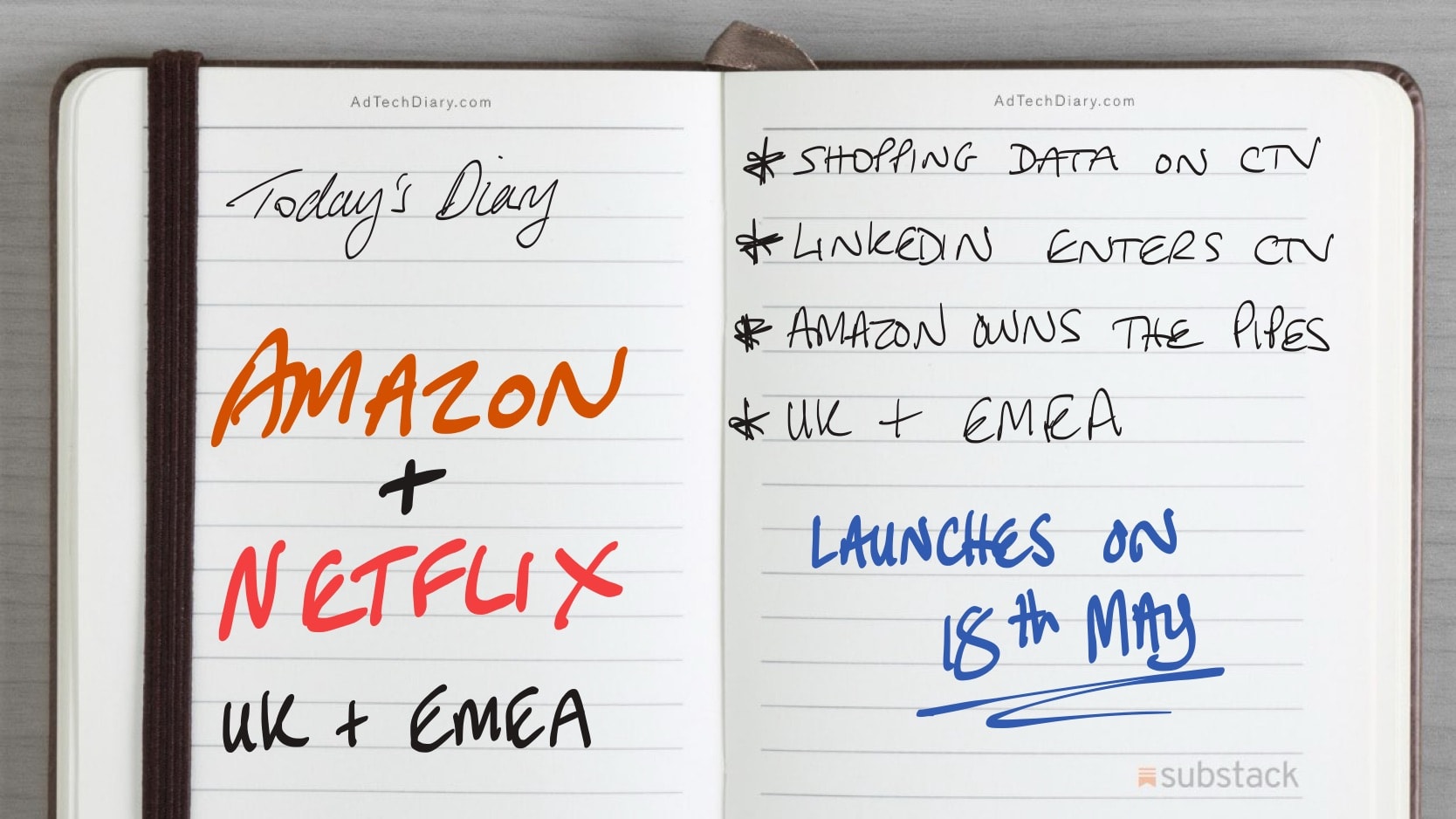
From 18 May in the UK and EMEA, advertisers using Amazon DSP can apply Amazon shopping and behavioural data directly to Netflix ad inventory.
Which means:
A sportswear brand can target people actively browsing running shoes on Amazon while they watch Netflix
A B2B advertiser can combine LinkedIn job title targeting with premium CTV inventory
Amazon now sits across the audience data, DSP, clean room, attribution and activation layers all at once
This is much bigger than “Netflix now available programmatically”…
It’s the merging of:
Retail media
Streaming TV
Commerce data
Professional identity data
Closed loop measurement
Into a single buying ecosystem.
For advertisers, this could massively improve targeting and attribution.
For broadcasters, it raises the pressure because premium TV inventory alone is no longer enough without commerce data attached.
And for the industry?
It’s another step toward a future where a handful of giant platforms own the audience, the pipes, the measurement and the definition of “performance” itself.
Which historically always ends calmly and transparently in adtech..
Somewhere in London, a planner is already pretending this was always the strategy.
The Slack message arrives at 8:12am.
“Can we get a POV on the Amazon x Netflix thing for the client by 10?”
No context. No briefing. Just panic wrapped in urgency.
Somewhere an agency trader is frantically Googling “what is AMC clean room” while another person updates a deck title from CTV Trends 2026 to Commerce Driven Premium Video Opportunities because everyone suddenly needs to sound like they’ve been talking about this for years.
And to be fair, this is a big one.
Starting 18 May, advertisers using Amazon DSP in the UK and EMEA can apply Amazon Audiences directly against Netflix inventory.
Which sounds harmless enough until you actually stop and think about what that means.
Because this is not just “Netflix inventory available programmatically”.
That already happened.
This is Amazon bringing purchase intent into one of the most premium logged in TV environments on earth.
Retail data meeting television.
Finally.
Or depending how cynical you are... unfortunately.
This Is Where It Changes
For years, CTV targeting has largely been a slightly posher version of demographic guessing.
“Adults 25 to 54 who enjoy prestige drama and probably own a sofa.”
Very scientific.
Meanwhile, retail media has been sprinting in the opposite direction.
Actual shopping signals.
Real purchase behaviour.
Verified intent.
Not inferred.
Not modelled.
Not “people who resemble someone who once bought hummus in Croydon”.
Actual data.
Now Amazon gets to apply that data against Netflix viewing.
Meaning a sportswear brand can target users actively browsing running shoes on Amazon while they watch Netflix on a Friday night pretending they’ll “definitely start training again Monday”.
That is an entirely different proposition to traditional TV planning.
And honestly, most of the industry still hasn’t caught up with what that means.
Because this isn’t just targeting anymore.
This is infrastructure convergence.
The DSP
The retailer
The clean room
The streaming platform
The identity layer
The commerce data
The logged in audience
All collapsing into one stack.
CTV spent years trying to prove it was digital TV.
Now retail media is proving TV can become digital retail.
Why Netflix Needs This More Than Amazon
And the really interesting bit?
Netflix probably needed this more than Amazon did.
For all the hype around Netflix ads, there has still been a quiet hesitation from parts of the market.
Not because the inventory is bad.
Far from it.
Netflix inventory is premium, logged in, brand safe and culturally dominant in a way most broadcasters would kill for.
But premium inventory alone is no longer enough when CFOs want measurable outcomes attached to every media pound spent.
The old “TV drives awareness” line still works right up until procurement joins the meeting.
Then suddenly everyone wants attribution diagrams.
This is where Amazon becomes extremely useful to Netflix.
Because Amazon doesn’t sell “reach”.
Amazon sells intent.
That distinction matters.
A lot.
Then LinkedIn Turns Up To The Party
And buried underneath all the applause is something even bigger.
Amazon is quietly repositioning itself from being “a DSP with shopping data” into potentially the most powerful operating system in premium advertising.
That sounds dramatic until you map the pieces.
Prime Video
Twitch
Freevee
Retail purchase behaviour
Alexa signals
Amazon Marketing Cloud
Netflix inventory
LinkedIn professional targeting
Yes. That part matters too.
Because on the exact same week this Netflix rollout expands into EMEA, Amazon also announces its LinkedIn partnership.
Meaning buyers can now combine retail purchase intent AND professional audience data against premium streaming inventory.
Think about how absurd that sentence would have sounded five years ago.
A B2B SaaS advertiser can theoretically target senior finance decision makers watching streaming TV while layering commerce intent signals into the buy.
Someone in enterprise sales just fainted into a HubSpot dashboard.
And somewhere else, an agency strategy deck now says “full funnel convergence” 37 times in size 9 font.
The Industry Is About To Call CTV “Performance” Again
And technically, they’re not entirely wrong anymore.
That’s the uncomfortable bit.
Because historically, CTV performance conversations have often been… generous.
A lot of expensive storytelling attached to suspiciously optimistic attribution windows.
Someone sees a TV ad.
Three weeks later they Google the brand.
A dashboard claims victory.
Everybody claps.
Now?
The pipes are becoming far more connected.
Amazon can increasingly see:
Exposure
Audience qualification
Downstream commerce activity
Inside its own ecosystem.
That changes the economics of television buying.
Particularly for FMCG and retail advertisers who already live inside Amazon’s data environment.
And this is where traditional broadcasters should probably start sweating slightly more aggressively.
Because the threat is no longer just “streaming”.
It’s data enriched streaming tied directly into commerce ecosystems.
That is much harder to compete against.
Especially when linear TV measurement still occasionally feels like archaeology.
Retail media stopped being a channel about eighteen months ago.
Most of the industry just hasn’t emotionally processed it yet.
The Bit Nobody Wants To Talk About
This is where the industry usually responds with a new acronym instead of therapy.
Meanwhile most clients still just want to know why CPMs keep increasing while reporting somehow becomes less clear every year.
And honestly, that confusion is fair.
Because beneath the shiny partnership announcements sits a more awkward reality.
The more consolidated this ecosystem becomes, the fewer independent layers remain.
Amazon increasingly owns:
The audience data
The buying platform
The activation environment
The measurement layer
The clean room
The commerce signals
At some point you do have to pause and ask:
Who exactly is auditing any of this independently?
Because this industry absolutely loves vertical integration right up until someone mentions transparency.
Then suddenly everybody develops selective hearing.
We’ve seen this movie before.
Adtech history is basically a repeating cycle of:
Fragmentation
Consolidation
Opaque optimisation
“Trust us”
Industry outrage
Repeat
The difference now is scale.
Amazon’s advertising business reportedly surpassed $70 billion annually.
That’s no longer “retail media growth”.
That’s infrastructure dominance.
And unlike most traditional DSPs, Amazon sits directly on top of commerce behaviour.
Which makes their positioning incredibly difficult to compete with.
Because while everybody else talks about audience intent…
Amazon can often literally see the basket.
That is a frightening advantage.
Particularly in a market increasingly obsessed with proving ROI inside economic uncertainty.
What UK Agencies Should Actually Do
And poor old agencies are stuck in the middle trying to explain all this to clients who still occasionally ask if Netflix ads can be skipped.
You can already see what happens next.
Every holding group will suddenly publish a thought leadership piece explaining how they’ve “always believed in converged commerce driven video ecosystems”.
Naturally.
There’ll be a webinar.
There’s always a webinar.
Someone will say “signal loss” fourteen times.
Someone else will mention “AI powered optimisation” while manually exporting CSVs from three platforms into Excel at 11:47pm.
The usual.
But beneath the theatre, there genuinely are practical implications here.
Especially in the UK market.
For retail advertisers
This becomes one of the first truly scaled opportunities to combine deterministic shopping intent with premium television viewing.
For B2B advertisers
The LinkedIn integration is arguably even more important.
CTV has historically struggled as a serious B2B environment because targeting was too broad and attribution too fuzzy.
Professional audience overlays change that.
Suddenly CTV becomes viable for enterprise campaigns that previously stayed inside LinkedIn video, YouTube or display ecosystems.
For measurement teams
Then there’s AMC.
Which sounds incredibly exciting right up until somebody actually has to explain clean rooms internally without sounding like they’re describing a science fiction prison.
But this is where the real long term value sits.
Not the targeting.
Not the inventory.
The measurement infrastructure.
Because whoever controls the clean room controls the narrative around performance.
And in modern advertising, narrative often becomes reality remarkably quickly...
If you actually want to understand how this machine works under the hood, I literally wrote the book on it called WTF IS PROGRAMMATIC.
The Bigger Problem
The irony is this entire industry spent years pretending retail media and TV were separate conversations.
Now they’re merging into the same supply chain.
Which means the people still organising agencies into rigid “performance”, “brand”, “commerce” and “programmatic” silos are about to have an extremely stressful couple of years.
Because consumers do not move through channels the way agency org charts do.
Never have.
The technology is finally catching up to that fact.
Messily.
Expensively.
With at least six overlapping dashboards and a deeply concerning number of identity graphs.
But still.
Catching up.
And somewhere right now, a junior trader is already building a Netflix audience segment called “high intent runners”.
Using data from people who bought protein powder once in February 2022.
Nature is healing.
This took me ages to research and write. All I ask is that you hit subscribe if you found value.
k, thanks, bye