

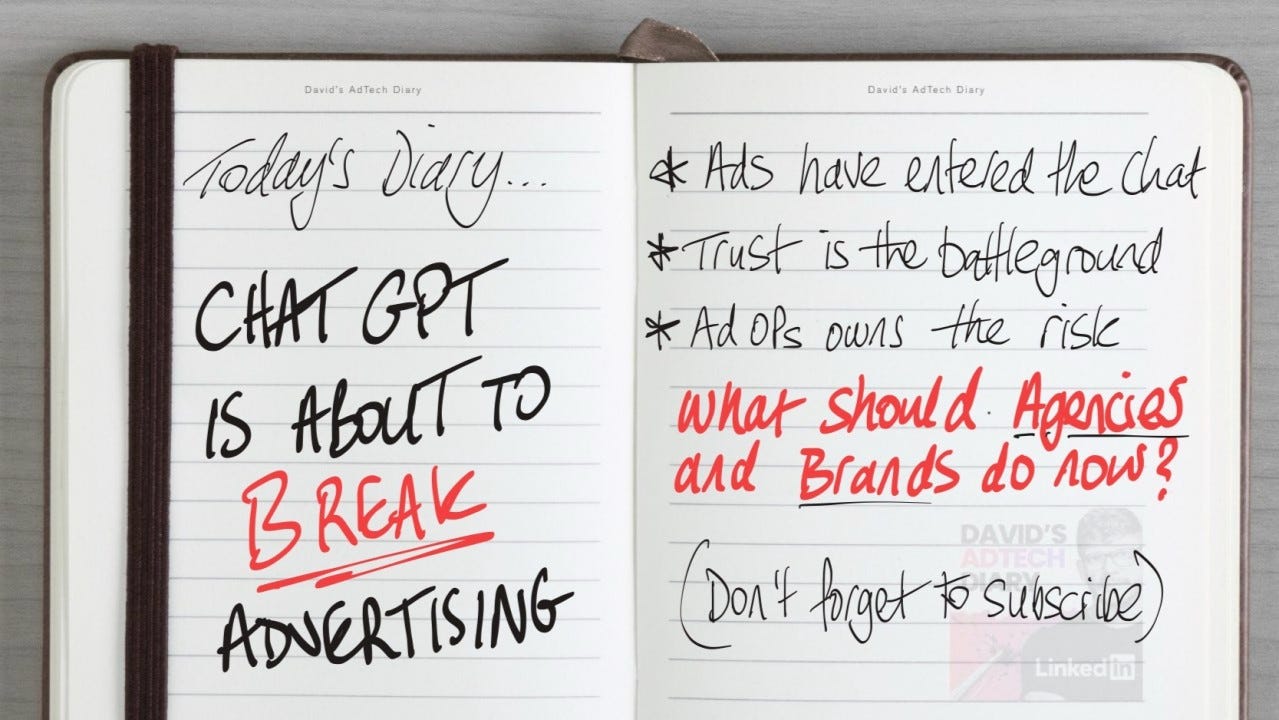
ChatGPT Is About to Break Advertising (or Reinvent It)
Advertising just crossed a line it’s never been allowed to cross before.

Back in October, I wrote a Diary piece on LinkedIn called OpenAI Just Declared War on Advertising.
At the time, it felt a bit like standing up at a dinner party and calmly explaining that the house was on fire while everyone else asked if you wanted another drink.
Plenty of nodding. A few likes. A lot of “interesting take” comments which, in LinkedIn language, means “this makes me uncomfortable so I’m going to ignore it.”
Fast forward to January and OpenAI has quietly done the thing everyone insisted wouldn’t happen.
They turned ads on.
Not loud ads. Not desperate ads. Not banners screaming for attention.
Calm, contextual, clearly labelled ads sitting politely at the bottom of a conversation people actually trust.
Which is worse.
Because this wasn’t a surprise. It was an inevitability.
October wasn’t wrong. It was just early. And in #AdTech, being early always looks dramatic until it suddenly looks obvious.
So wtf is going on?
This is not OpenAI casually launching an advertising product. This is OpenAI changing where advertising is allowed to exist.
For the past few decades ads have lived around intent.
Search results. Social feeds. Content environments.
You say something, then advertising waits nearby hoping to be relevant enough to be tolerated.
Conversational AI flips that entirely.
The interface is the experience.
The response is the value.
And now advertising has been invited into the same space as the answer itself.
It’s no longer inventory. It’s becoming very intimate...
OpenAI has been very careful to explain the rules.
Free users see ads.
Paid users don’t.
Ads are contextual to the current query, not your entire chat history.
No politics.
No health.
No kids.
Clear labelling.
Easy dismissal.
Opt-out options.
All very sensible. All very reassuring. And completely missing the point.
Trust doesn’t care about policy documents.
People just don’t use ChatGPT the way they use Google.
They don’t “search.” They explain themselves.
They ask follow-ups. They admit uncertainty.
They test ideas.
They ask questions they wouldn’t type into a search box with someone walking past their desk.
That’s the contract.
So the moment advertising appears there, even politely, the burden on brands becomes enormous.
If the AI gets something wrong, your brand isn’t adjacent to unsafe content. It’s standing next to it like you agree.
That’s a very different risk profile.
Which is exactly why AdOps leaders should be paying attention now, not when a sales deck lands in their inbox.
If you’re agency side, this breaks a few comfortable assumptions.
You cannot treat this like another activation line item. There is no “we’ll test with 5% of budget and optimise later” safety net.
The first conversations your clients appear in will define how much trust they’re allowed in this environment.
Your job here isn’t buying. It’s governance.
You should already be thinking about who signs off conversational creative, how AI adjacency fits into existing brand safety frameworks, and what happens when a client asks why their brand appeared next to an answer they didn’t script.
If your response is “that’s just how the platform works” you’re already exposed.
You also need to prepare clients for the uncomfortable truth that performance metrics will lag behind reality.
There will be influence without clicks.
Impact without attribution.
Senior operators who can’t explain that calmly are going to struggle.
If you’re brand side, the risk is different but sharper.
This is not a place to experiment with brands that don’t already have authority.
If your value proposition can’t stand up inside a conversation without shouting, it will feel invasive very quickly.
Before you even think about spend, you should be asking whether your product, your claims, and your tone make sense when surfaced next to a trusted answer.
If the AI is doing most of the explaining, your ad needs to add value, not repeat marketing copy.
This is also where internal alignment matters.
Legal, comms, and media teams can’t work in silos when the brand is appearing inside AI responses.
Someone needs ownership of the conversational risk profile, and right now most organisations don’t even know that role exists.
And for AdOps leaders specifically, on either side of the fence, this is the real shift.
Your job is no longer just delivery and efficiency. It’s interpretation.
You’re going to be the ones explaining why something “worked” without a clean CPA.
Why something “failed” without any obvious error.
Why a platform that technically behaved correctly still created reputational discomfort.
This doesn’t behave like search advertising, no matter how hard everyone wants it to.
There are no blue links.
No fixed placements.
No comforting keyword lists that make planners feel in control.
Just fluid intent expressed in natural language, with nuance and emotion baked in.
Great for relevance. Awful for control.
And measurement?
We’re nowhere near ready. Not even close...
There’s no meaningful bidding logic yet.
No placement guarantees.
No intent taxonomy anyone agrees on.
No attribution model that can explain whether a conversation nudged someone forward or just nodded politely in their direction.
This is pre-programmatic and anyone pretending otherwise is selling a deck.
What makes this even more interesting is how differently everyone else is reacting.
Google is doing that thing where it says ads are coming, then says they’re not, then goes very quiet and watches carefully. That’s not confusion. That’s fear of getting it wrong in public.
Anthropic has opted out entirely. Subscription revenue. Enterprise clients. Clean lines. Predictable income. Boring, but safe.
Perplexity paused. And when publishers start asking awkward questions, the whole room changes temperature very quickly.
OpenAI, though, went first.
And going first means you absorb the user backlash, the buyer confusion, and the early mistakes so everyone else can learn quietly behind you.
That’s the real gamble.
Because if conversational ads work without breaking trust, this becomes the default interface for commerce.
If they don’t, the damage is reputational, not just commercial.
For media buyers, the instinct will be to rush in looking for cheap beta CPMs and screenshots for decks. That’s 100% the wrong move.
The advantage here isn’t scale. It’s learning.
Learning how creative works when the context is a sentence, not a keyword.
Learning how brand safety applies when tone and phrasing matter more than URLs.
Learning how to show up helpfully without sounding like you’re hijacking the conversation.
In this environment, authority beats optimisation every single time.
Which is why October mattered...
The direction of travel was obvious if you stopped thinking about ads as formats and started thinking about them as interruptions.
Conversational AI doesn’t tolerate interruption. It notices it.
So no, OpenAI didn’t suddenly declare war on advertising in January.
It just confirmed the battlefield some of us were already pointing at in October...
Oh, and if you actually want to understand how this machine works under the hood, I literally wrote the book on it called WTF IS PROGRAMMATIC?
This took me ages to research and write. All I ask is that you hit subscribe above^ if you found value.
k, thanks, bye