

Criteo’s $1 Billion Quarter Is Hiding A Much Bigger Retail Media Problem
Criteo’s Q1 results exposed the shift happening across retail media. Spend is still growing, but falling revenue and major client losses showed that scale alone is no longer enough.

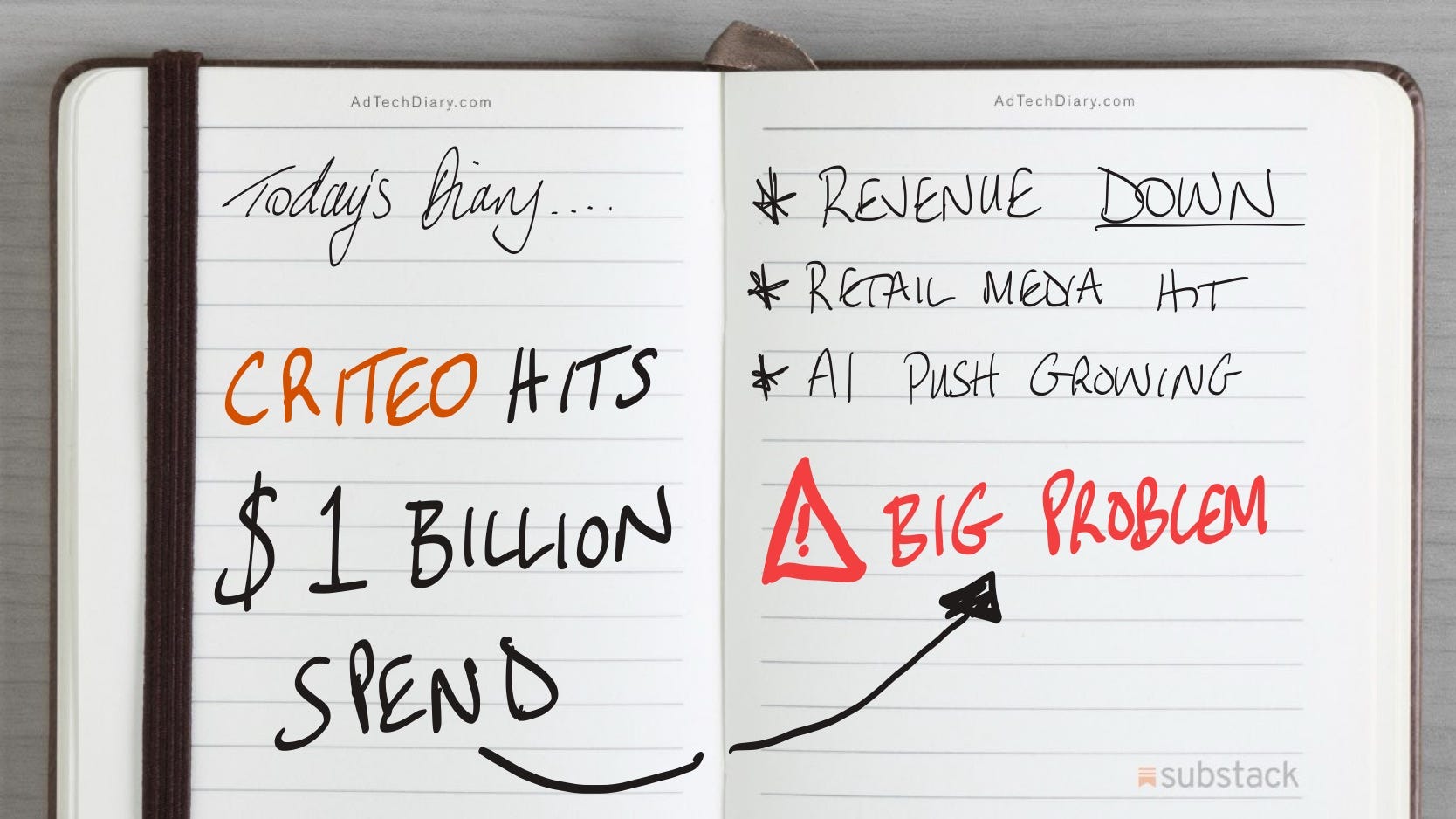
I was reading through the Criteo Q1 earnings release while simultaneously getting three separate LinkedIn messages about “AI powered commerce transformation”.
That pretty much sums up AdTech in 2026.
One screen shows the reality.
The other shows the pitch deck.
Because Criteo’s latest quarter is one of the clearest examples I’ve seen recently of a business trying to manage two completely different narratives at the same time.
On one side, the company is clearly still scaling.
Advertiser spend crossed $1 billion during a first quarter for the first time in its history.
Active customers grew around 10%.
Commerce media adoption continues expanding.
Retail media relationships remain extensive globally.
The underlying platform still appears commercially relevant.
On the other side, the financial pressure is impossible to ignore.
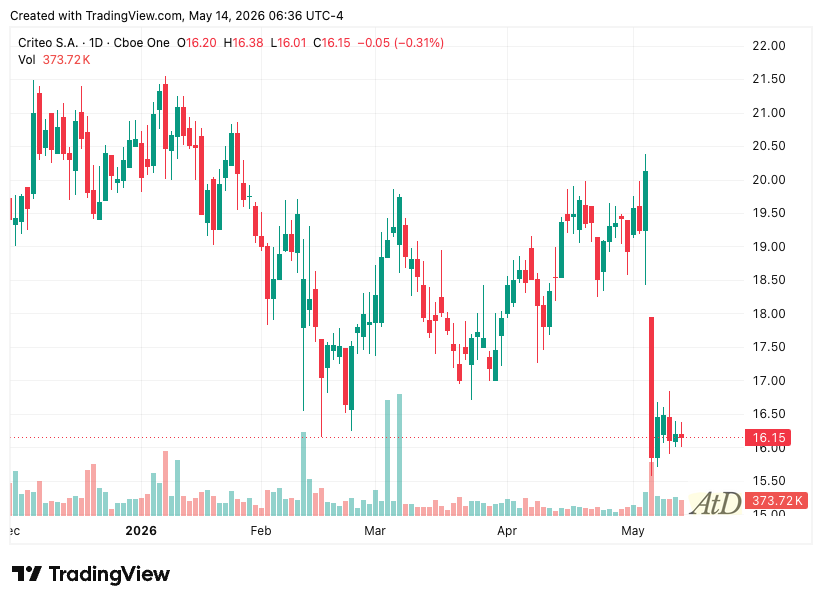
Revenue declined.
Net income collapsed.
Retail media revenue took a major hit.
The stock continued falling.
And the market reaction showed very clearly that investors no longer reward “future potential” unless they can also see near term operational stability.
That tension is the real story.
Because too much analysis in AdTech still tries to force companies into simplistic categories.
Winning.
Losing.
Disrupting.
Dying.
The reality is usually much messier.
Most large AdTech platforms are now sitting in awkward transition phases where parts of the business are growing strongly while other parts are structurally under pressure at the exact same time.
Criteo is one of the clearest examples of that dynamic right now.
The $1 Billion Headline Sounds Bigger Than It Is
The billion dollar advertiser spend figure matters.
That is not a meaningless milestone.
It tells you brands are still actively using the platform at scale.
It tells you media buyers still see performance value.
It tells you commerce media budgets continue moving through the ecosystem despite macroeconomic pressure.
But advertiser spend alone does not guarantee platform health anymore.
For years, AdTech rewarded growth narratives almost blindly.
If spend increased, investors assumed platform power was strengthening.
If retail media budgets expanded, everyone assumed the category was permanently protected from the pressures hitting the rest of programmatic advertising.
Now we are seeing what happens when retail media starts behaving less like an emerging growth category and more like an actual mature media business.
And mature media businesses are exposed to concentration risk, pricing pressure, margin compression and competitive fragmentation.
That is exactly what this quarter exposed.
The Real Problem Is Dependence
The Roundel and Uber Eats exits are not just unfortunate client losses.
They are reminders of how dependent parts of the AdTech ecosystem have quietly become on a relatively small number of enormous commercial relationships.
That dependence changes how businesses operate internally.
It affects product roadmaps.
It affects pricing strategy.
It affects investor expectations.
It affects hiring.
It affects forecasting.
It affects how aggressively companies pursue exclusivity agreements.
And most importantly, it affects resilience.
Because once revenue concentration reaches a certain level, even strong underlying platform performance can struggle to offset the commercial impact of losing a handful of giant contracts.
That is where Criteo finds itself now.
What makes the situation interesting is that the underlying platform metrics are not actually weak.
The company continues expanding its advertiser base.
Its commerce media infrastructure remains globally relevant.
Its same retailer contribution retention figure excluding the largest client losses remained positive.
Its first party commerce data capabilities still hold significant strategic value in a market increasingly shaped by identity fragmentation and privacy pressure.
Those are not signs of a platform that has lost all relevance.
But relevance and stability are not the same thing.
And this is the problem the wider retail media industry is starting to encounter.
Retail Media Is Entering Its Difficult Phase
For the last few years, retail media has effectively been treated as the safest growth story in digital advertising.
Retailers discovered they were sitting on highly valuable purchase intent data.
Advertisers wanted deterministic attribution.
Third party cookie deprecation accelerated urgency around first party data strategies.
Commerce environments became increasingly attractive because they connected media exposure to transaction outcomes more directly than traditional open web advertising.
The result was predictable.
Money flooded in.
Every major holding group built retail media divisions.
Commerce media became a permanent fixture inside conference agendas.
AdTech vendors repositioned themselves around retail narratives almost overnight.
Retailers started launching media networks at a pace that became borderline absurd.
At one point it felt like every supermarket, pharmacy chain and ecommerce platform suddenly believed they were the next Amazon Advertising.
Some of those ambitions were realistic.
Many were not.
Because building a retail media business is not the same as monetising banner inventory.
The operational complexity becomes enormous very quickly.
You need identity infrastructure.
Measurement infrastructure.
Sales capability.
Data governance.
Attribution frameworks.
Cross channel integrations.
Agency relationships.
Demand generation.
Yield management.
Creative support.
Privacy compliance.
And eventually, once the easy growth phase slows down, you also need differentiation.
That is where things become difficult.
Everyone Now Sounds The Same
Most retail media platforms are now competing for the same budgets from the same advertisers using increasingly similar positioning language.
Everyone claims closed loop attribution.
Everyone claims AI powered optimisation.
Everyone claims cookieless targeting.
Everyone claims commerce intelligence.
Everyone claims full funnel capability.
From the buyer side, the platforms often start blending together operationally.
That creates downward pressure on pricing and platform take rates.
Criteo is already feeling some of that pressure.
Even where advertiser spend grows, revenue growth does not necessarily scale proportionally anymore because buyers are demanding more efficiency and competition across commerce media continues intensifying.
And this is where the AI conversation enters the picture.
Every major AdTech platform now understands that “AI powered optimisation” is the easiest narrative bridge between slowing growth and future investor optimism.
But the useful part of AI in advertising is not the branding language.
It is operational leverage.
That is the real battleground.
Can AI improve conversion probability?
Can it lower acquisition costs?
Can it optimise bidding more effectively?
Can it personalise creative dynamically without damaging brand quality?
Can it improve forecasting accuracy?
Can it reduce waste across fragmented omnichannel campaigns?
Those are commercially meaningful problems.
Everything else is mostly presentation.
Why The OpenAI Partnership Actually Matters
Criteo’s OpenAI partnership signals management understands this shift.
The company is trying to position itself not just as a retail media infrastructure provider but as an optimisation engine sitting across commerce environments.
Strategically, that makes sense.
Because competing purely on inventory access becomes difficult once retailers themselves become more technologically mature.
The long term value sits in optimisation capability and measurable commercial performance.
The challenge is that every major platform is moving toward exactly the same conclusion.
Amazon DSP is aggressively strengthening commerce integration.
The Trade Desk continues expanding retail partnerships.
Google still dominates huge parts of performance advertising despite constant industry frustration.
Retailers themselves are building internal capabilities.
Agencies are investing directly into commerce intelligence and proprietary tooling.
Everyone is compressing toward the same operational territory which means differentiation becomes incredibly difficult.
Agencies Are Quietly Exhausted
This is also why agency sentiment toward AdTech platforms has become noticeably more sceptical over the last 18 months.
Not because buyers suddenly dislike innovation.
Quite the opposite.
The problem is operational fatigue.
Most agency teams are now managing extraordinary levels of platform complexity simultaneously.
Multiple DSPs.
Multiple attribution models.
Conflicting measurement methodologies.
Fragmented identity frameworks.
Retail media reporting inconsistencies.
CTV expansion.
Privacy regulation changes.
AI tooling integration.
Cross channel optimisation expectations.
Meanwhile clients still expect simple answers.
“Why did performance change?”
“Why does this dashboard not match the retailer numbers?”
“Why are attribution windows different?”
“Why did CPMs rise?”
“Why are conversion figures inconsistent again?”
This is the hidden reality underneath most of the “future of commerce media” industry content.
The people inside trading teams are exhausted.
So when platforms talk about AI powered transformation, agencies increasingly judge those claims through one lens only:
Does this actually make operations simpler and performance stronger?
If the answer is no, the narrative becomes irrelevant very quickly.
Retail Media Is Growing Up
The next stage of retail media evolution will look very different from the last one.
The first phase was driven by expansion.
New retailers.
New budgets.
New partnerships.
New inventory.
New platform launches.
The next phase will be driven by consolidation and operational efficiency.
Which platforms genuinely improve outcomes?
Which platforms integrate cleanly?
Which platforms survive margin compression?
Which platforms retain major clients?
Which platforms scale internationally without operational chaos?
Which platforms maintain advertiser trust when economic pressure increases?
Those questions matter far more now than whether another retailer launches a sponsored products offering.
And honestly, this transition was inevitable.
Every high growth sector eventually reaches the point where operational fundamentals matter more than narrative momentum.
Retail media has now reached that point.
That does not mean the category is collapsing.
Far from it.
Commerce data will remain strategically valuable for years.
Advertisers still want measurable transaction outcomes.
Retailers still control powerful first party datasets.
Cross channel commerce activation will continue expanding.
But the market is becoming less forgiving.
Investors are less patient.
Agencies are more demanding.
Brands want clearer commercial accountability.
Procurement teams are scrutinising margins harder than ever.
That environment exposes weaknesses much faster.
The Next Two Quarters Matter More Than The Last Two Years
Which brings us back to Criteo.
The company is effectively trying to navigate three major transitions simultaneously.
Recovering from major client losses.
Repositioning itself around AI driven commerce optimisation.
Proving its retail media infrastructure remains scalable and resilient despite revenue disruption.
That is not easy.
But it is also not impossible.
The most important detail in the earnings release for me was not the billion dollar advertiser spend milestone.
It was the evidence that underlying engagement and retention remain relatively healthy once the outsized contract losses are excluded.
Because that suggests the platform itself still provides real commercial utility.
The danger would be if advertiser usage itself started deteriorating materially.
That would indicate structural irrelevance.
We are not seeing that yet.
Instead we are seeing something more complicated.
A platform with genuine strengths operating inside a market that is becoming structurally harder.
That distinction matters because the wider AdTech industry is heading toward exactly the same reality.
Growth alone is no longer enough.
Narrative alone is no longer enough.
AI branding alone is definitely no longer enough.
Operational resilience is becoming the defining metric.
Can these platforms survive when the easy growth phase ends?
That is the question investors are asking now.
That is the question agencies are asking quietly behind closed doors.
And over the next 12 months, it is the question retail media platforms will have to answer properly.
This took me ages to research and write. All I ask is that you hit subscribe if you found value.
k, thanks, bye