

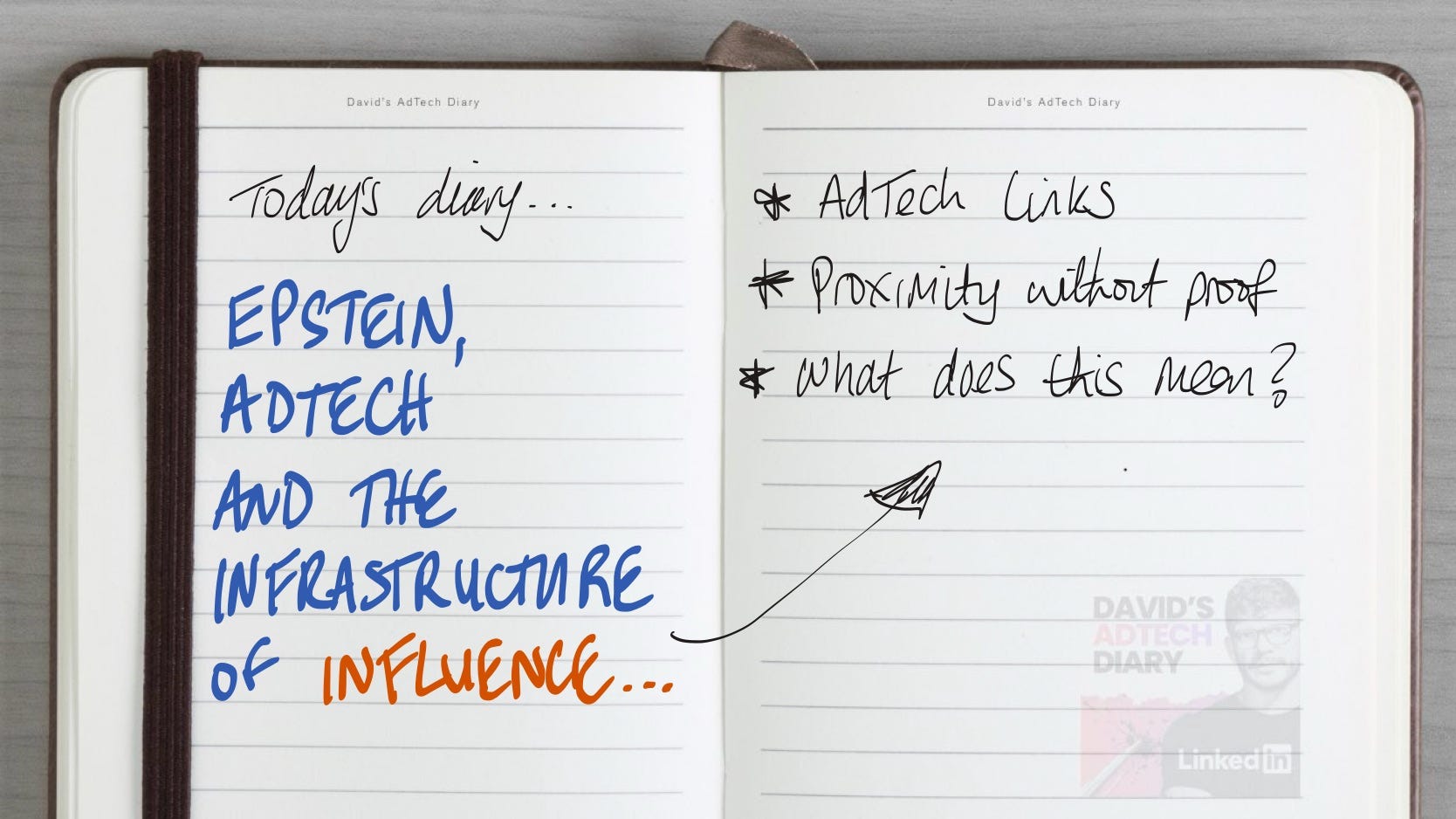
Epstein, AdTech And The Infrastructure Of Influence
The real story is not who emailed Epstein. It is how AdTech became infrastructure for influence.

Victoria McNally, writing for AdExchanger, published “Inside The Epstein Files: Tracing His Links To Digital Advertising.”
It is careful. Documented. Measured.
She does not allege crimes.
She does not imply guilt.
She traces connections that appear in DOJ released files.
That matters.
But once you move past the surface reaction, a more interesting question appears.
What does this actually reveal about AdTech?
And what does it change?
First, let’s be honest about what it is not
The article is not a smoking gun.
The Ad/Fin example reads like standard venture activity:
• $875,000 invested
• 4.29 percent ownership
• An instruction to exit at cost
That is not sinister. It is dull.
The Dstillery reference?
Minimal correspondence.
No financing.
A spokesperson confirming no engagement.
Again, nothing explosive.
Publicis?
A $1 million wire tied to a Clinton Global Initiative event.
Budget disputes.
Revenue breakdown requests.
Lawyers cc’d.
That is corporate workflow, not cinematic conspiracy.
Even the Havas adjacency, where a board level figure appears over 3,800 times in the files, centres on PR strategy and reputation rehabilitation.
Uncomfortable? Yes.
Illegal in itself? No.
So if we strip away heat, what are we left with?
Proximity.
And proximity is where the real story lives.
AdTech does not create power. It services it.
AdTech sits close to capital.
Capital sits close to power.
Power attracts reputational risk.
Therefore AdTech will always end up in the orbit of controversial figures.
Not because the industry is uniquely immoral.
Because it is uniquely useful.
If you want to:
• Influence search results
• Shape public perception
• Optimise visibility
• Clean up digital association
• Get access to emerging tech networks
You need infrastructure.
We built that infrastructure.
We built systems that determine what is seen, what trends and what gets buried.
That is literally the commercial promise of large parts of the ecosystem.
This is where the problem actually starts
Most operators like to frame AdTech as neutral.
“We just run the media”
“We just build the tools”
But neutrality at scale is not neutral in impact.
If reputation repair can be productised, someone will buy it.
If perception can be engineered, someone will engineer it.
If search visibility can be manipulated, someone will manipulate it.
The tools do not ask moral questions and the incentive model asks only one question.
Is it legal and paid?
And that is where things get interesting.
Because legality and ethics are not synonyms.
What proximity journalism does well
McNally’s article performs an important function.
It documents.
It connects dots.
It reminds the industry that we operate in rooms shared with elite finance.
That reminder matters.
Too many people in AdTech pretend we are a scrappy optimisation layer.
We are not.
We are infrastructure for influence.
And infrastructure attracts power.
The article exposes adjacency without melodrama.
That is responsible journalism.
Where it stops short
But here is where I think the industry conversation needs to go further.
Listing connections creates heat.
But it does not interrogate structure.
The more uncomfortable questions are:
• What red lines do agencies actually have?
• Do platforms refuse certain forms of reputation repair?
• What governance frameworks exist when clients carry serious allegations?
• Do boards intervene or does revenue override?
Because that is where the ethical tension actually lives.
Not in who emailed who.
In how influence infrastructure behaves when capital seeks rehabilitation.
Proximity stories generate attention.
Structural analysis generates accountability.
They are not the same thing.
Nobody wakes up thinking they are doing something morally questionable.
They are:
• Taking a meeting
• Reviewing a deck
• Joining a board
• Facilitating a financing round
• Drafting a PR strategy
Every step feels commercially rational.
Reasonable.
Normal.
Until context shifts.
And history rewrites it.
That is how power embeds itself.
Not through dramatic villain monologues.
Through inboxes and calendars.
Through processes that look exactly like yours.
The second order effects
If AdTech continues to frame itself as purely neutral infrastructure, three things happen.
Governance remains reactive rather than proactive.
Ethics becomes a compliance checklist rather than a board level discussion.
The industry continues to be surprised when its tools are used in ways that feel uncomfortable.
And yet nothing changes.
Because the commercial incentive remains intact.
As long as influence can be monetised, influence will be sold.
The only question is whether we are honest about that.
The real value of this story
It forces operators to confront proximity to power.
And proximity to power always carries risk.
Not legal risk necessarily.
Reputational risk.
Strategic risk.
Moral risk.
If you are building tools that control attention, you are building leverage.
Leverage attracts people who need it.
That is the structural reality.
So what should the industry actually do?
Not panic.
Not perform outrage.
Be mature.
That means:
• Establishing explicit ethical guardrails beyond legal minimums
• Defining red line client policies
• Elevating influence risk to board level conversations
• Treating narrative engineering as a power function, not just a revenue stream
Because pretending we are just optimising CPMs is how we avoid responsibility.
And that avoidance is far more dangerous than any proximity headline.
Final thought
Credit to Victoria McNally at AdExchanger for surfacing documented links clearly and without sensationalism.
But the real conversation is bigger than the names in the files.
AdTech does not sit at the edge of influence.
It sits in the middle of it.
And if we are honest about that, then the only serious question is not who appeared in an email thread.
It is whether this industry is prepared to accept the weight of the power it has built.
Because neutrality, when you control visibility at scale, is rarely neutral in consequence.
Oh, and if you actually want to understand how this machine works... I literally wrote the book on it — WTF IS PROGRAMMATIC?
I appreciate your attention.
k, thanks, bye.