

Expedia's First-Party Data Just Hit The Open Web Via Magnite. Here's What To Do Next (Before Everyone Else Does)
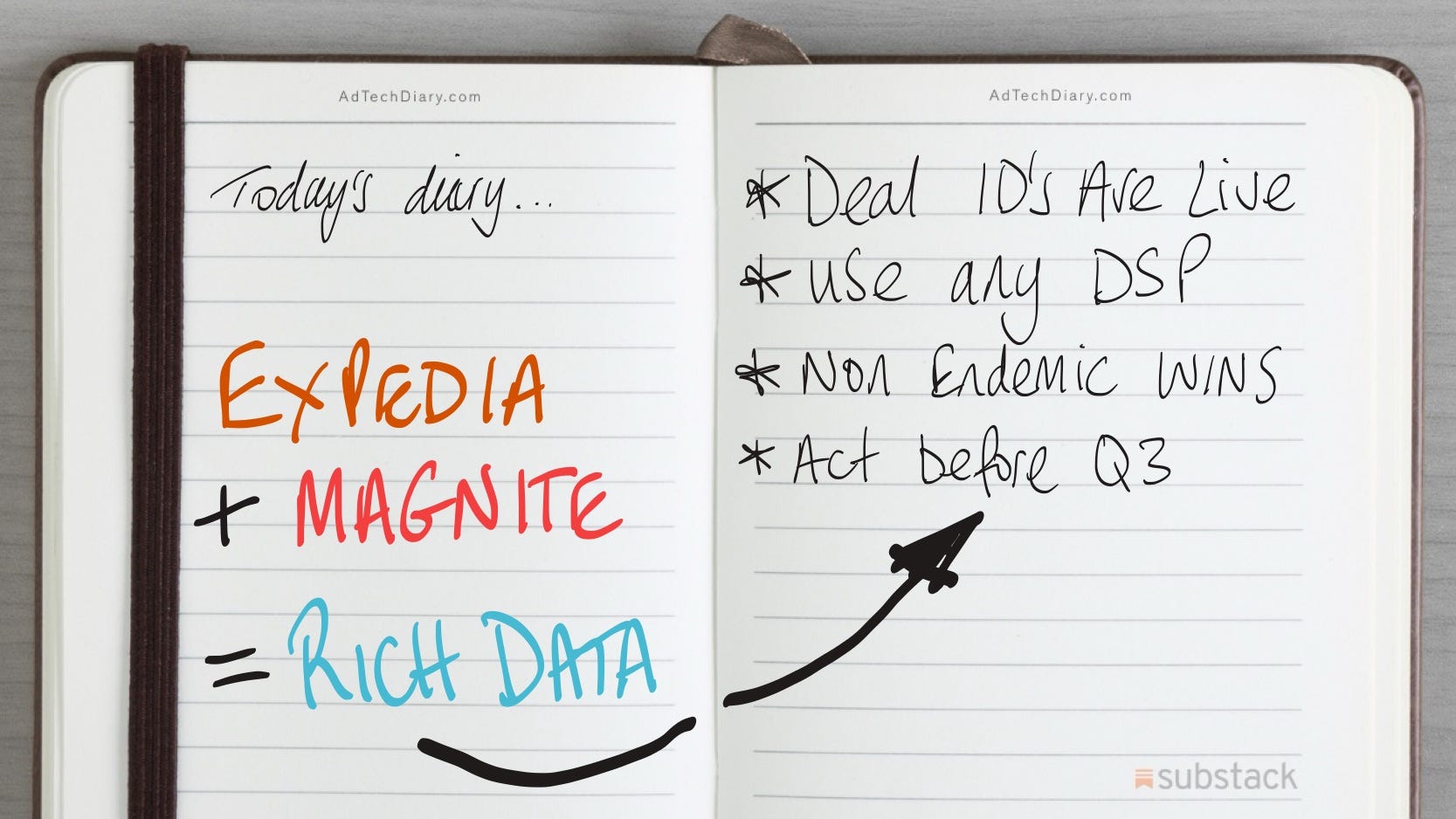
Expedia knows who books business class, stays in five-star hotels, and travels four times a year. Via Magnite, that data is now available to any advertiser programmatically. Here's what to do.

There’s a ritual in agency land.
A big partnership gets announced. Someone screenshots it into a WhatsApp group. Three people say “interesting” and one person says “we should look at this.”
Then nobody looks at it.
The Expedia Group Advertising × Magnite deal (announced 16 April 2026) is going through that ritual right now. In three hundred different agencies simultaneously.
This one actually matters. Try to stay awake.
The numbers, since apparently those help
$758 million in ad revenue in 2025.
Up 19% year-on-year.
Expedia built a proper media business and most of the industry was too busy debating cookie deprecation timelines to notice.
Until now, almost all of it was on-platform.
Sponsored listings.
Display units.
Catching a traveller on Expedia.com while they were already mid-booking... at the precise moment they needed your ad the fuc*king least lol.
Magnite changes that.
Expedia’s audience data leaves the building. It goes off-platform, into CTV, streaming audio, display, online video... reaching the same consumers while they’re doing something entirely unrelated to travel.
200 petabytes of first-party intent data.
Not modelled.
Not a dodgy lookalike built from someone’s expired cookie pool.
Real behavioural signals from real booking activity across Expedia, Hotels.com, and Vrbo.
Yep.
Destinations.
Dates.
Hotel tiers.
Flight classes.
Frequency.
It’s unreal data.
It’s been locked inside Expedia’s ecosystem the entire time. And the industry’s response, thus far, has been to put it in a Slack thread.
The non-endemic opportunity that everyone is about to ignore
Right. Pay attention folks. This is the part that actually matters.
Someone who books business class regularly is not merely a travel customer.
They are a high-income, high-intent, high-spend consumer profile that half the financial services, automotive, luxury, and technology sector would do genuinely embarrassing things to reach at scale.
Historically, Expedia’s data was largely accessible only to travel brands.
Airlines targeting frequent flyers.
Hotels targeting people who’d already stayed in hotels.
An entire ecosystem of travel advertisers reaching travel audiences and congratulating themselves on their
relevancestupidity
The Magnite partnership blows that open.
Non-endemic advertisers... financial services, automotive, luxury retail, tech... can now reach Expedia-defined audiences while those consumers are watching television, listening to a podcast, or reading the news.
Not on Expedia.
Not in a travel context.
Just... there. Available. Targetable.
A person booking a £600-a-night hotel room in London is, by almost every measure, the exact consumer your wealth management client has been trying to reach for three years.
Yet most agencies will file this under “travel partnerships” and forward it to their airline account. It’s un-fu*king believable, really.
The architecture, for those who like to understand things before activating them…
The integration is DSP-agnostic.
Deal IDs through Magnite’s SSP layer.
Works inside whatever platform an agency already uses.
No new login.
No proprietary interface.
No six-month onboarding process with a dedicated success manager who only replies to emails on Thursdays at 2:57AM your time.
Magnite brings the premium publisher supply... CTV, video, display, audio, brand-safe environments.
Expedia brings the audience intelligence.
Pre-negotiated.
Curated.
Fewer bidding wars.
Better match rates.
Cleaner targeting than anything you’d get fumbling around in the open auction hoping for the best.
Most programmatic “strategies” are just open auction buying with a targeting spreadsheet attached. This is not that.
The supply path is curated specifically to reduce the chaotic, wasteful, self-competing mess that open auction buying produces at scale.
It’s a better structure.
It exists right now.
Agencies are already explaining why they need another quarter to “evaluate” it.
The broader context, briefly, because it’s important
Amazon figured this out.
Walmart figured this out.
Kroger figured this out.
The entire retail media sector spent five years proving that first-party purchase-intent data, routed through programmatic infrastructure, is more valuable than almost anything else in the advertising stack.
Travel data is just better.
A supermarket loyalty card tells you someone bought semi-skimmed milk.
Expedia tells you someone booked a first-class flight to New York, a five-star hotel, and a rental car... three times this year.
The difference between this and retail media walled gardens is that Expedia routes through an independent SSP.
Agencies keep transparency. They keep attribution portability. They don’t get locked into a proprietary reporting environment that conveniently makes everything look brilliant.
Some people in this industry have been burned by walled gardens before. They know exactly what I’m talking about. The rest will find out.
If you actually want to understand how this machine works under the hood, I literally wrote the book on it called... WTF IS PROGRAMMATIC?
What to actually do, since apparently that needs spelling out
The launch timing is deliberate.
Peak travel planning season runs from April to June.
Intent signals on Expedia’s properties are at maximum volume and recency right now... not in Q3, not post-summer… right now!
Wait three months and you’ll be presenting a “Q4 opportunity” to a client who needed it in May. Don’t be that person.
Non-endemic first. Financial services, automotive, luxury, tech…
Any client who’s spent the last two years asking how to reach wealthy, high-intent consumers at scale... answer the question. Brief it in this week.
Activate inside your existing DSP.
There is no blocker here. The deal is DSP-agnostic. If someone in your agency says “we need to onboard first” while spitting their tuna sandwich at you... they are describing a process that simply does not exist. Push back.
Test the cross-channel reporting properly.
Multi-format campaign. CTV, display, audio. Actually stress-test the attribution output rather than nodding along at the case study and copy-pasting the numbers into a credentials deck 18 months from now.
Keep it away from endemic clients initially.
Travel brands will find this themselves. The strategic value is in walking into a financial services or luxury retail brief with an audience proposition that nobody else has brought them yet.
That’s the conversation worth having right now.
This took me ages to research and write. All I ask is that you hit subscribe if you found value.
k, thanks, bye
Love this! So insightful!