

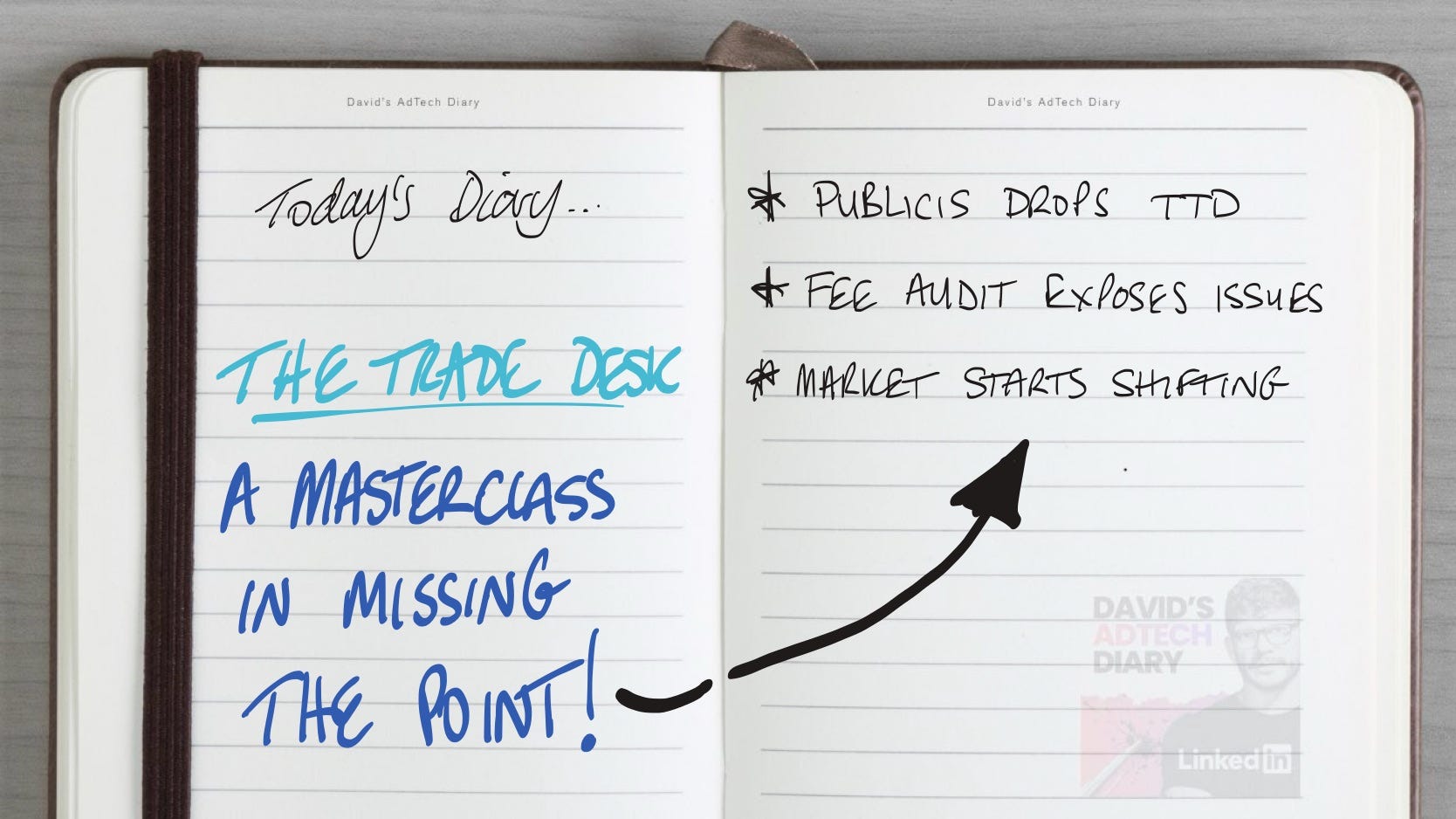
The Trade Desk: A Masterclass in Missing the Point
Publicis has effectively dropped The Trade Desk after a fee audit raised questions about billing, consent, and transparency. Slight problem... transparency was their entire pitch.

The first sign of trouble in adtech is rarely dramatic.
It is usually Lee in finance asking this very boring question on a Tuesday… or in this case an audit commissioned by Publicis.
“Can anyone explain this line item?”
Five tabs open.
One person says it is probably just reporting.
Someone else pops out for a coffee and never comes back.
That is normally the moment you find out whether your “clean commercial model” is actually clean, or just explained confidently enough that nobody pushed back.
Because for the best part of a decade, The Trade Desk has walked into every room like it was the only honest person at a party full of pickpockets.
We are transparent.
We are different.
We are not like those agencies.
It had a slightly familiar tone.
A bit like that Brexit bus that promised to save us £350 million a week.
Confident. Repeated. Sounds great in a room.
And to be fair, it worked…
Very well.
Right up until a FirmDecisions audit, commissioned by Publicis, found that The Trade Desk had applied DSP fees beyond agreed limits, enabled paid tools without clear client consent, and could not provide enough documentation to verify cost pass through.
Without asking…
That’s like a locksmith fitting an extra lock on your door, not giving you the key, and invoicing you afterwards.
Not helpful. Expensive. Completely uninvited.
This is where it stops being a commercial disagreement and starts being a credibility problem.
Because they chose to be the transparent one.
Nobody forced that.
It was the strategy.
And it paid off for a long time.
Right up until someone asked to see the inner workings.
You do not get to spend ten years building a business on openness and then get vague when someone asks for the numbers.
If the numbers are clean, you show them.
It is that simple.
Transparency is not a narrative. It is whether someone else can follow the money without help.
Then came the response…
Jeff Green took to LinkedIn and decided the best move was to point out that agencies are not exactly transparent either.
Which is true.
Also completely beside the point.
It is the corporate version of getting caught speeding and explaining that other drivers do it too.
Accurate, yes.
Irrelevant, also yes.
And slightly insulting to everyone listening.
Because this is not a morality contest.
This is a billing question.
Nothing makes this industry more philosophical than a question about fees.
And yes, the agency world has its own problems.
Principal media has created plenty of fog.
Margins hidden in efficiency.
Inventory dressed up as strategy.
Commercial models that look very different depending on who is asking.
The whole thing is a glass house. Just ask WPP.
Everyone throwing bricks.
Everyone acting surprised when the windows break and shocked when innocent people get cut by the shards.
But that does not change the core issue.
If you sell yourself as the clean one in a messy market, you do not get the same margin for error.
You get less. Much less, actually.
Most programmatic strategies aren’t strategies. They’re just expensive guessing.
This was already under pressure before any of this became public.
Growth had started to slow.
Expectations had started to shift.
Amazon at the door.
The story was already getting harder to tell.
And then this lands.
The market reaction was immediate.
Not because one audit changed everything overnight.
But because it confirmed something people were already starting to whisper about in Ad Land.
The audit did not create the problem.
It revealed it.
That is the bit people keep missing.
Amazon DSP has been getting stronger.
CTV has been getting messier.
Competition has been getting tighter.
The narrative was already wobbling.
This just switched the lights on.
And once the lights are on, everything gets looked at properly.
There are also signals this is not isolated.
Multiple holding groups stepping back.
Similar concerns appearing in different places.
One exit is politics… three? Well that starts to look like a verdict.
At what point does an industry disagreement become an industry conclusion?
This is the part the market has been turning a blind eye to for years.
DSPs have not been scrutinised nearly as hard as they should have been.
Everyone loves talking about optimisation, supply paths, identity, AI, all the clever bits.
But fees?
Those get treated like background noise.
Accepted.
Assumed.
Rarely challenged.
A client would never accept mystery fees on an IO.
But wrap it in a polished interface and suddenly it feels normal.
A lot of adtech is just well presented confidence.
A shiny dashboard has hidden more problems than bad strategy ever has.
This is where buyers need to get more serious.
If you are spending serious money through any DSP and cannot clearly explain:
how fees are applied
what tools are active
who approved them
what you are actually paying for
…then you do not have control.
You have risk.
Same goes for automation.
The Trade Desk has been pushing further into AI driven optimisation with Kokai and Performance Mode.
In another week, that would be the headline.
Automation. Efficiency. Smarter buying.
Instead it lands in the middle of a transparency issue.
Which makes it harder to sell.
Because automation only works when trust holds.
If buyers are already questioning fees and permissions, handing more control to the system is a tougher conversation.
It really feels like it’s upgrading the autopilot while people are still asking how the brakes work.
There is also the OpenAI angle…
Potential new inventory.
Potential new growth story.
Fine.
But more inventory does not solve accountability.
It just gives you more places to be questioned.
This is not just about The Trade Desk.
It is about an industry that treated transparency like a slogan instead of a system.
Something you say.
Not something you prove.
Until someone asks.
If an audit can wreck your week, the problem started long before the audit.
So what should actually happen now?
Review contracts.
Tighten audit rights.
Make cost pass through explicit.
Document tool approvals properly.
Benchmark performance against at least one alternative.
Not because multi DSP is automatically better.
But because dependency feels very different when questions start getting asked.
If you actually want to understand how this machine works under the hood, I literally wrote the book on it called WTF IS PROGRAMMATIC?
Because eventually, someone checks.
And when they do, everything has to survive contact with a spreadsheet.
That is where most of the storytelling ends.
I genuinely like TTD and the good people who work there (I actually do) and this will certainly not kill them… only Amazon wants to see that happen!
But it does remove the luxury of being unquestioned.
And once that goes, everything gets a bit more real… for everyone.
k, thanks, bye