

Why Publicis Is Really Buying LiveRamp
The real power in advertising is no longer just media buying scale or creative capability. It is whoever controls the layer between client data and execution.

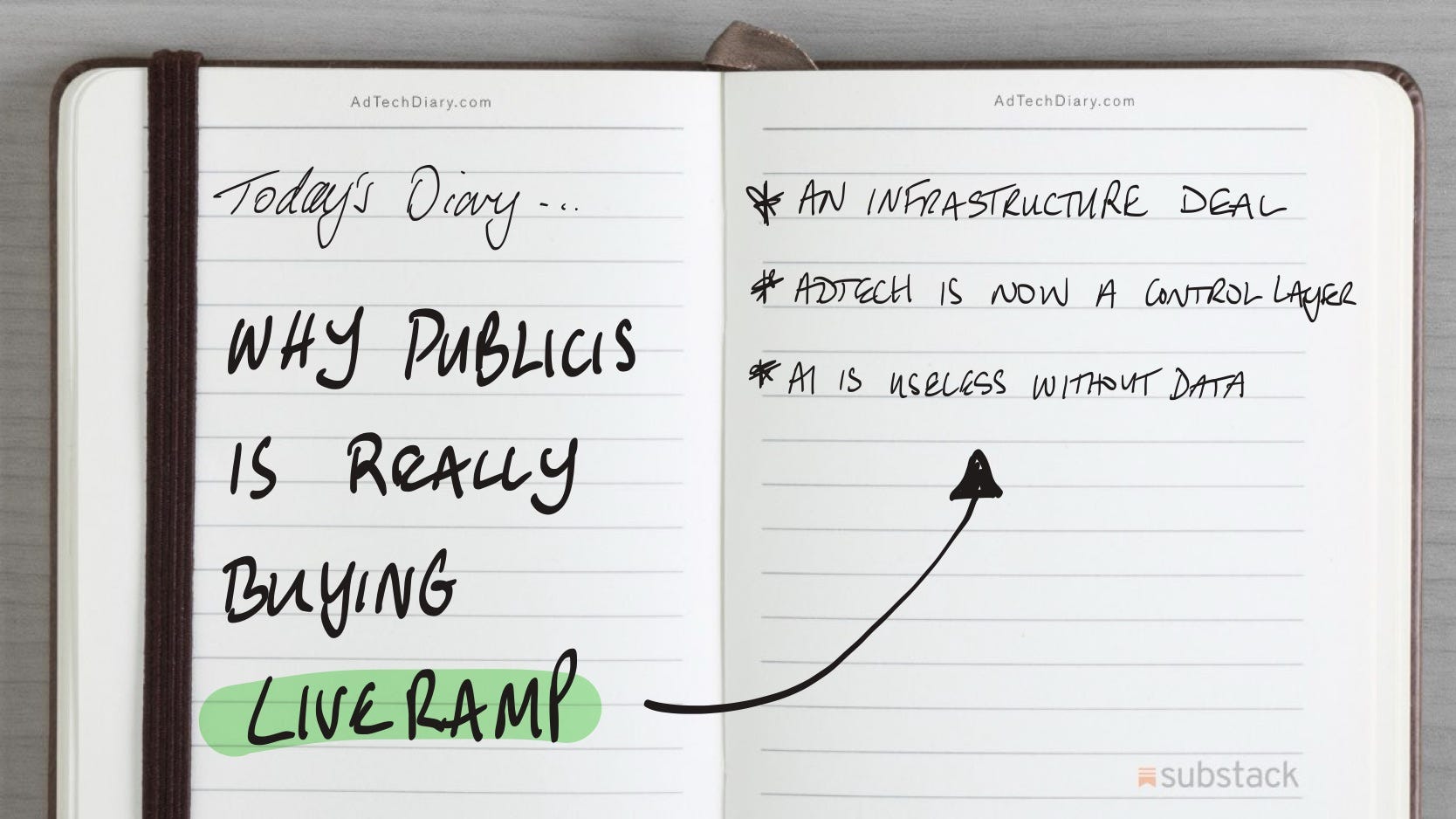
Publicis is acquiring LiveRamp in an all cash deal valued at roughly $2.2 billion enterprise value, with a total equity value of $2.546 billion including net cash, to strengthen its position in identity, data collaboration, activation and measurement infrastructure.
This morning I watched people frame the Publicis acquisition of LiveRamp like it was another predictable holding company expansion story.
“Bigger agency buys smaller adtech company.”
More scale.
More capabilities.
More consolidation.
Standard industry narrative.
But the more I looked at the deal, the more obvious it became that this is not really about scale at all.
It is about infrastructure.
That is the bit I think the market still struggles to talk about properly because most advertising conversations are still trapped at the surface layer.
People focus on campaigns.
Media buying.
Creative.
Retail media growth.
AI tools.
Planning systems.
But the real strategic value in modern advertising increasingly sits underneath all of that.
The companies gaining leverage are the ones controlling the plumbing between data, identity, activation, measurement and decisioning.
That is what Publicis is actually buying.
And honestly, this deal says more about where adtech is heading than almost anything else announced this year.
The market has shifted underneath the industry
For years, agency groups competed largely on three things:
Scale
Relationships
Execution
If you had buying power, operational reach and strong client relationships, you could build a defensible position.
But modern advertising has become structurally more complicated.
Cookies weakened.
Identifiers fragmented.
Platforms closed themselves off.
Retail media exploded.
CTV fragmented.
Measurement became harder.
Privacy rules increased.
Cloud infrastructure changed how data moved.
At the same time, every major advertiser started demanding the same thing:
Help us make our first party data actually useful.
That changed everything.
Because suddenly the value was no longer just in buying media efficiently.
The value moved toward whoever could connect fragmented systems together.
That means:
Connecting CRM data to activation
Connecting retailer signals to campaigns
Connecting publisher data to measurement
Connecting cloud environments to DSP workflows
Connecting identity across environments
Connecting outcomes back to spend
That is the real operating layer now.
And LiveRamp sits directly in the middle of it.
LiveRamp is more important than most people realise
A lot of people still describe LiveRamp like it is simply an identity company.
That massively undersells what it actually does inside the ecosystem.
LiveRamp effectively acts as connective tissue between upstream data and downstream execution.
Upstream data includes:
CRM systems
Transaction data
Retailer data
Publisher audiences
Cloud warehouses
Offline records
Customer signals
Downstream execution includes:
DSPs
CTV platforms
Retail media environments
Clean rooms
Measurement systems
Activation endpoints
Analytics tools
LiveRamp helps make all of those systems interoperable.
That matters because modern advertising is incredibly fragmented operationally.
Every platform wants its own identifier.
Every retailer wants its own media network.
Every publisher wants its own audience layer.
Every cloud environment has different workflows.
Without interoperability, marketers end up with disconnected systems everywhere.
That fragmentation creates operational drag.
And operational drag is becoming one of the biggest commercial problems in adtech.
AI actually makes this problem bigger
This is the part I think the industry still gets wrong…
Everyone keeps talking about AI like it reduces the importance of infrastructure.
In reality, AI makes infrastructure more valuable.
Because AI systems only work properly if the underlying data layer works properly.
You cannot automate fragmented chaos effectively.
You just accelerate bad workflows faster.
An AI agent is only as useful as the systems it can access.
If identity is broken, permissions are unclear and data environments do not connect together cleanly, AI becomes incredibly limited operationally.
That is why Publicis keeps talking about “data co-creation” and “smarter agents”.
The language sounds promotional on the surface.
But underneath it is a serious strategic point.
AI needs governed identity infrastructure.
AI needs interoperable data systems.
AI needs clean activation workflows.
Without those things, most AI execution in advertising becomes shallow automation sitting on top of operational fragmentation.
And honestly, a lot of the current market hype already feels exactly like that.
Publicis is building an operating system
That is why this acquisition makes more sense when you stop thinking about Publicis like an agency group.
Because increasingly it is trying to position itself as an enterprise operating partner.
Look at the stack they are building.
Epsilon gives them:
Identity capability
Customer data infrastructure
Sapient gives them:
Enterprise transformation capability
Systems integration
Marcel gives them:
Internal orchestration
AI workflow infrastructure
LiveRamp now adds:
Interoperability
Collaboration capability
Cross ecosystem activation
Together, that creates something much closer to a horizontal operating layer for marketing execution.
Not just campaign buying.
Not just creative delivery.
Not just consulting.
Actual infrastructure.
And infrastructure is harder to replace than services.
That distinction matters commercially.
A campaign can move agencies.
An infrastructure dependency becomes embedded operationally.
That changes the economics completely.
Why Publicis bought instead of partnered
This is probably the clearest signal in the entire deal.
Publicis already worked with LiveRamp.
They did not need to acquire the company to access the technology.
So the decision to buy tells you management believes ownership creates more long term value than partnership access alone.
That usually comes down to control.
Owning infrastructure means:
Controlling roadmap priorities
Improving integration depth
Capturing more margin
Reducing external dependency
Strengthening differentiation
Blocking competitors from accessing the same leverage
And honestly, that last part matters more than people admit publicly.
Because infrastructure assets like LiveRamp are relatively scarce.
There are not many companies sitting at the intersection of identity, collaboration, activation and measurement with broad ecosystem relevance.
So owning one changes competitive positioning.
Particularly in a market where every holding company is now trying to build a more defensible AI and data story.
The holding company model is evolving
The bigger story here is that agency groups are quietly transforming into something else entirely.
Traditional agency structures were built around labour.
Creative teams
Media teams
Planning teams
Operations teams
But margins in pure services businesses become harder to defend over time.
Infrastructure changes that equation.
Because infrastructure creates embedded workflows and operational dependency.
That is why the industry keeps drifting toward data and technology acquisitions.
Not because holding companies suddenly want to become software vendors.
But because infrastructure creates more defensible commercial positioning.
And the competitive set is changing too.
Publicis is no longer competing only against WPP or Omnicom.
It is competing against:
Consultancies
Cloud providers
Retail media ecosystems
Commerce platforms
AI workflow vendors
Enterprise transformation firms
That means owning more operational infrastructure becomes strategically important.
The neutrality problem is the entire risk
This is where the deal becomes genuinely interesting.
Because LiveRamp only works properly if the market trusts it.
That trust is the asset.
Its value comes partly from neutrality.
Advertisers use it.
Publishers use it.
Retailers use it.
Platforms use it.
If the ecosystem starts believing LiveRamp primarily exists to advantage Publicis clients, the network effects weaken.
That is the balancing act.
Publicis needs enough integration to create commercial advantage.
But not so much integration that the market stops treating LiveRamp like neutral infrastructure.
That tension will define whether this acquisition succeeds.
And honestly, this is much harder than the acquisition announcement makes it sound.
Because neutrality is not judged by press releases.
It gets judged by behaviour.
Product prioritisation
Pricing
Governance
Partnership decisions
Data access structures
Commercial incentives
Every ecosystem participant will now watch those decisions extremely carefully.
This changes expectations for agencies
I think this deal also raises the standard for the wider agency market.
Because clients increasingly expect agencies to explain how their data infrastructure actually works.
Not just campaign performance.
Not just media buying.
Actual operational architecture.
Questions like:
How does identity resolution work?
How does measurement work across environments?
How does retailer data connect into activation?
How does AI access governed data safely?
How do clean rooms integrate operationally?
How do fragmented systems become interoperable?
These are now commercial conversations. Not technical side discussions.
And agencies that cannot answer them properly will increasingly struggle to differentiate.
Because the market is shifting from execution quality toward infrastructure credibility.
Retail media makes this even more important
Retail media is accelerating this trend massively.
Because retail media creates another huge layer of fragmentation.
Every retailer has its own:
Data environment
Measurement logic
Identity structure
Activation process
Workflow model
Brands are already overwhelmed operationally.
They do not want another twenty disconnected ecosystems.
So the value increasingly shifts toward platforms capable of stitching those environments together coherently.
That is another reason LiveRamp matters strategically.
It sits across environments rather than inside only one.
That interoperability becomes incredibly valuable as retail media expands globally.
This is really about control underneath the workflow
The simplest explanation for this deal is probably the most accurate one.
Publicis wants deeper control over the infrastructure underneath modern advertising execution.
Not just campaigns.
The actual workflow layer itself.
That means:
Identity
Data portability
Measurement
Collaboration
Activation
AI orchestration
Privacy governance
Interoperability
Those are the strategic control points now.
And honestly, most of the industry still talks about them like secondary operational details rather than the core competitive layer.
That feels increasingly outdated.
Because whoever controls those layers controls how modern advertising actually functions operationally.
What happens next
I do not think every holding company suddenly rushes out to buy a LiveRamp equivalent.
There probably are not many equivalent assets available anyway.
But I do think this accelerates infrastructure competition across the industry.
Expect more:
Alliances
Interoperability deals
Identity investment
Measurement consolidation
Workflow integration
AI orchestration positioning
Because this acquisition sends a very clear signal:
The future competitive battleground in advertising is not just media execution. It is ownership of the systems connecting data, identity, activation and outcomes together.
That is the real shift happening underneath the market.
And honestly, once you see the industry through that lens, a lot of recent adtech moves suddenly make much more sense.
I do not think Publicis is buying LiveRamp because it wants another capability.
I think it is buying leverage.
Leverage over the infrastructure layer sitting underneath modern addressable advertising.
That is a very different strategic ambition.
And whether the deal succeeds probably comes down to one central question:
Can Publicis create differentiated commercial advantage from LiveRamp without destroying the neutrality that made the platform valuable in the first place?
Because if they can balance those two things properly, this may end up being remembered as one of the defining infrastructure plays of the modern adtech era.
This took me ages to research and write. All I ask is that you hit subscribe if you found value.
k, thanks, bye