

Yahoo’s DSP Has Crossed The Line...
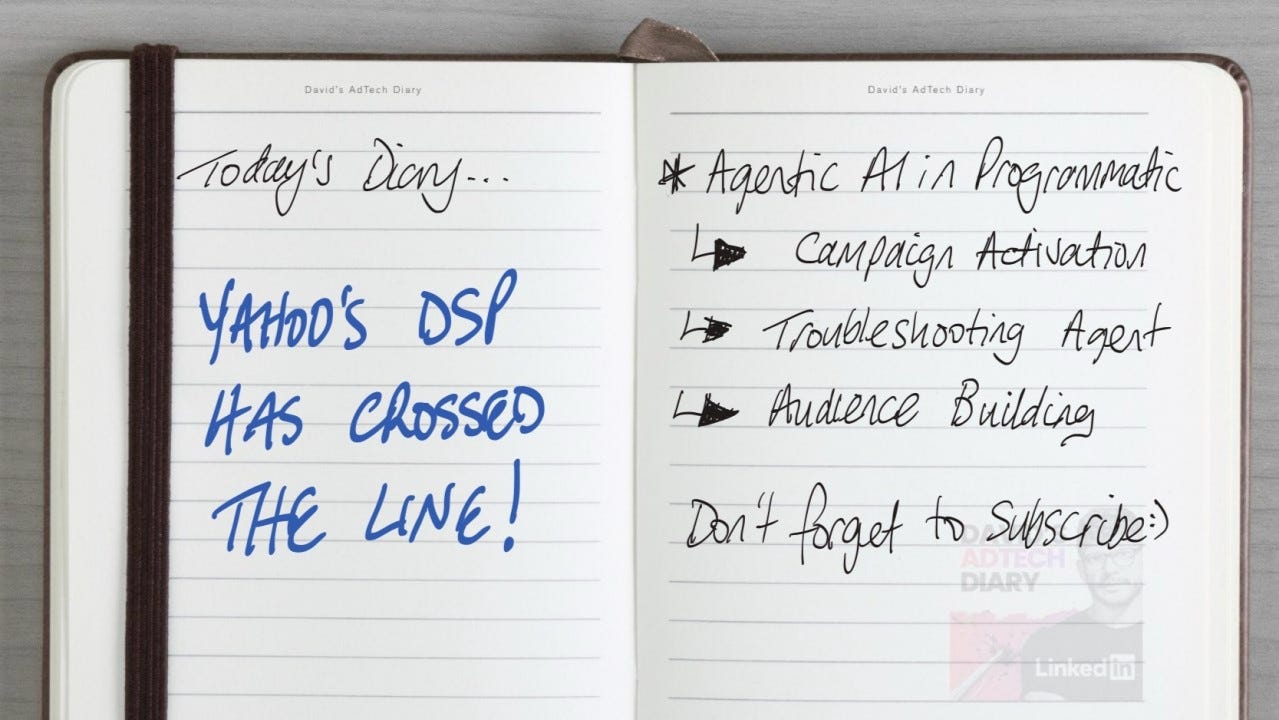
Yahoo DSP has quietly launched agentic AI that does not just recommend what to do. It actually does the work.

8am. Coffee in one hand. Slack pinging like a fruit machine.
Then I read the AdTech news.
Not a chatbot. Not a fancy insight panel. Not a helpful nudge saying you might want to look at line item 3.
Actual AI agents running inside Yahoo DSP executing tasks autonomously.
And suddenly my coffee went cold... again.
Because this is the moment the industry stops talking about AI like it is a helpful intern and starts admitting it is closer to a junior trader who never sleeps.
Yahoo is rolling out THREE live capabilities straight away.
A campaign activation agent that lets you connect external AI agents via Model Context Protocol.
A troubleshooting agent that proactively identifies pacing and delivery issues.
And audience exploration that uses AI to discover and build audiences through APIs.
Pause on that for a second.
Troubleshooting. Proactively. Before a human even notices.
Every agency in the world is built on the assumption that someone spots something is broken. Then they investigate. Then they fix it. That entire loop has just been compressed into seconds by a system that does not need a status meeting to function.
This is not optimisation advice. This is execution.
And yes before anyone panics... Yahoo has wrapped this in something called the “Yours Mine and Ours framework”. Bring your own AI. Use Yahoo’s native agents. Or connect both together securely.
Which is a polite way of saying you are not forced into a black box but you are now responsible for what you plug in.
This is the line in the sand moment.
For years DSPs have talked about automation. Smart bidding. Algorithmic optimisation. Auto everything. But the human was always the bottleneck. Still pressing the button. Still debugging the mess when it went wrong.
That bottleneck is now being removed.
The real shift here is not speed. It is posture.
Programmatic has always been reactive. Something breaks. Someone spots it. Someone fixes it. Now we are moving to proactive campaign management where issues are identified and resolved before they ever make it into a report or a client email.
That is both brilliant and deeply uncomfortable.
Most agency time is spent on diagnosis not strategy.
We do not spend hours being clever. We spend hours figuring out why something that should work is not working. Why spend is stuck. Why delivery dropped. Why a deal is not matching. Why pacing is off. Why reporting looks wrong. Why the dashboard does not tie back.
If an AI agent can do that in seconds then a large chunk of what we call operational expertise just disappeared.
That does not mean people disappear. It means the job changes.
The most important line in the announcement was almost throwaway but it matters more than anything else.
Agency teams will need new skills around prompting agents through natural language and understanding agent decision logic to override automated actions when necessary.
Read that again.
This is not about learning a new DSP interface. It is about learning how to manage systems that manage campaigns.
Prompting becomes a skill. Oversight becomes a skill. Knowing when to let the agent run and when to intervene becomes the job.
If you cannot explain why the agent did what it did then you cannot responsibly use it.
This is where a lot of people are about to feel exposed.
The industry has spent years rewarding speed and execution. Who can build fastest. Who can traffic quickest. Who can juggle the most campaigns. That skill set does not map cleanly into an agent driven world.
In this model the best operators are not the fastest clickers. They are the best supervisors.
They understand objectives deeply enough to encode them clearly.
They understand risk well enough to set guardrails.
They understand measurement well enough to sanity check outcomes.
And crucially they understand how these systems optimise so they know when something smells off.
This is why I keep coming back to guardrails.
I took my kids bowling recently. They had the rails up. Without them the ball would have lived permanently in the gutter.
With them they could actually compete.
They could focus on throwing instead of constantly correcting failure.
They achieved scores they would never have hit otherwise.
That is exactly what AI should be in programmatic.
Guardrails up. Humans still playing the game.
Yahoo’s approach is interesting because it openly acknowledges this. The Yours Mine and Ours framework is essentially saying we know you will not fully trust us and that is fine. Bring your own brain. Plug it in. Let them talk to each other.
Partners like Newton and RPA have already built trafficking agents that have executed programmatic guaranteed buys.
Read that again.
Guaranteed buys executed by agents. No one manually building line items at 23:30 before launch.
That is not a roadmap slide. That is live.
But here is the bit people will quietly ignore until it hurts.
If an agent can activate. Troubleshoot. Explore audiences. Optimise. QA. Measure.
What exactly is the human accountable for when something goes wrong.
Because something will go wrong.
Not because AI is bad but because objectives are messy. Data is messy. Clients are messy. The real world is messy.
When an agent overshoots frequency. Or prioritises the wrong outcome. Or optimises away brand safety in pursuit of efficiency.
Who owns that decision.
You cannot just say the algorithm did it anymore.
You chose the agent. You set the prompt. You defined the guardrails.
Accountability moves up the stack.
That is why this announcement matters far more than most people realise.
It is not about Yahoo catching up on AI buzzwords. It is about redefining how programmatic teams actually operate.
If you are an agency leader and your value story is still we manually optimise better than anyone else... you have about 11 months to rethink that if you’re lucky.
If you are a trader and your main differentiator is knowing where the buttons are you need to start learning how these systems think.
If you are a client and you believe humans touching every lever equals control you are about to be disappointed.
The smart agencies like SBS will lean into this.
They will build frameworks where AI handles boring repeatable diagnosis and humans focus on outcomes judgment and governance.
They will train teams to interrogate agent logic not just trust dashboards. They will stop selling effort and start selling decision quality.
The bad ones like... (you so wanted me to name one ha) will pretend this is just another feature update.
They will switch it on without understanding it. They will panic when something weird happens. And they will quietly turn it off while telling clients they prefer a human touch.
That will work for a while.Then the economics will catch up.
When tasks that used to take hours... now take seconds... clients will start asking why they are still paying for hours.
That is the real disruption here.
Not job loss. Not AI panic. Margin pressure.
Agentic DSPs compress time. Time is what agencies sell whether they admit it or not.
The only defensible position is to move up the value chain.
Outcomes. Governance. Risk management. Strategic judgment. Being the adult in the room when the machine gets too confident.
Btw.. if you actually want to understand how this machine works under the hood I literally wrote the book on it — WTF IS PROGRAMMATIC?
This is not the end of human media buying... but it is the end of pretending the job is about clicking things.
The future trader looks less like a pilot manually flying and more like air traffic control.
Watching systems. Intervening when needed. Making judgment calls machines cannot.
Yahoo just made that future very real indeed.
This took me ages to research and write. All I ask is that you hit subscribe above^ if you found value.
k, thanks, bye